Plan ahead Commercial · Toronto
Master Key System Design
A self-storage operator wants the office, the tenant gate and the equipment shed on three different levels of access for staff, but every lock on the property currently answers to the same handful of interchangeable keys handed out over the years.
Call now · open 24/7(289) 806-2827In plain words
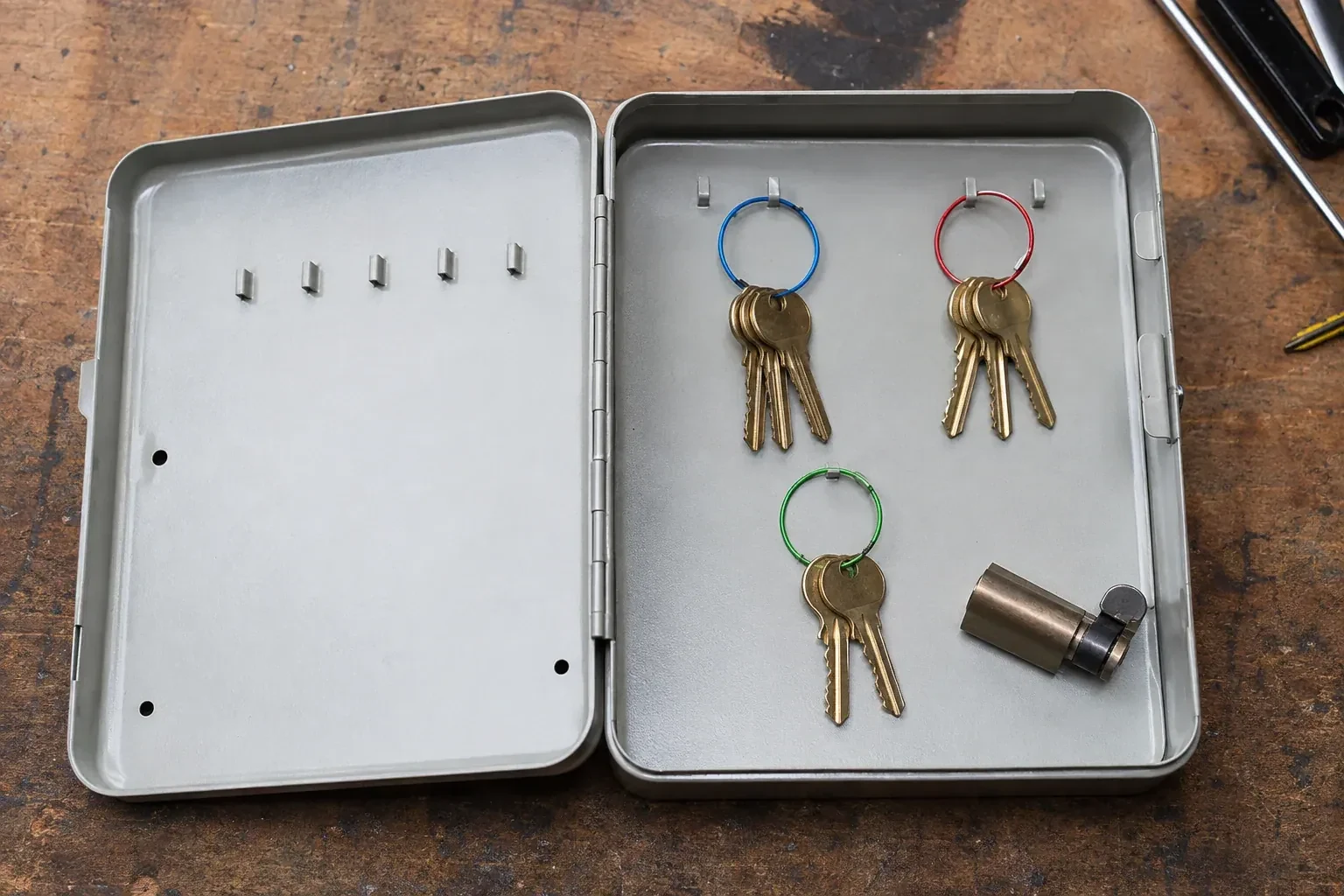
Master key system design is the work of turning a property's separate locks into one coherent hierarchy: a change key for an individual door, a sub-master over a department or floor, and one top-level master reserved for the few people who need it. The locksmith records who should open what, matches that list to the cylinders already installed or to new ones chosen for the job, and pins every lock so each key opens exactly its intended group. The finished system comes with a chart the owner controls, so access follows the organization instead of following whoever happened to be handed a spare key.
How the visit goesA new hire at the shop gets handed whatever spare key happens to be in the drawer, and it turns out to open the stockroom, the back office and the safe room all at once. The owner realizes nobody actually decided who should open what.
Master Key System Design · Toronto
How the visit goes
- 1
Who holds the top-level master
A single top-level master, if the property has one at all, is deliberately kept to the shortest list the business can operate with. The check here is a direct conversation about who genuinely needs to open every door on the property versus who only thinks they might one day, since every extra holder is another way a full-access key can go missing. This conversation happens before cutting begins, because narrowing the list afterward means recovering and replacing keys that have already been issued to people no longer on it.
- 2
Building the hierarchy from the bottom up
Design starts with the smallest unit, the individual change key, and works upward. Each door that stands alone gets its own combination; doors that should share access are grouped under a sub-master; and a single top-level master is reserved for the short list agreed earlier. Building in this order keeps the levels honest, since a sub-master or master is only created where a real group of doors justifies it, rather than being added because it seems useful in the abstract. The result is a hierarchy that matches the organization rather than one imposed on top of it.
- 3
Knowing exactly what a lost key affects
If a key goes missing later, the chart tells the business precisely which doors that level can reach, rather than leaving anyone guessing whether the whole property needs attention. That scope can then be compared against how the key was likely lost and who else already holds that same level, so the response, whether rekeying one group, one door, or leaving it recorded and monitored, is a decision made with real information.
In the van
- Change and master keys
- Locking chart storage cabinet
- Plug follower and key gauge
- Compatible replacement cylinders
- Bench test fixture
What affects the quote
- 1
Any optional upgrade chosen along the way
Some businesses use the project as an opportunity to also upgrade a door closer, add a keypad to one entry, or reinforce a strike plate. None of this is required for the master key system itself, and each optional item is quoted as its own line.
- 2
Administrator training and handover time
Walking the named administrator through the chart, the issuance process and how to handle a future lost key or new hire takes a defined amount of time on the day of handover, and a more detailed walkthrough for a larger, multi-level system takes longer than a simple one.
- 3
Keyway chosen: standard or restricted
A restricted or patented keyway costs more in blanks and administration than a standard keyway, since duplication is controlled through the manufacturer's authorized record rather than cut anywhere. Higher-risk doors, such as records or cash rooms, often justify that additional control; lower-risk doors may not.
Same fees day, night or weekend.
Master Key System Design: questions
Can cleaners or contractors get limited access without a master key?
Yes. A change key or a narrow sub-master covering only the areas they service is the usual approach, rather than handing over a level that reaches further than the job requires. Where the property uses keypad or card access alongside mechanical keys, a time-limited or role-specific electronic credential can serve the same purpose without a physical key changing hands at all.
Can electronic locks be part of the same system as mechanical keys?
Yes. Where a property mixes keypad or card doors with mechanical cylinders, the access levels are designed to line up across both, so a department sitting at one sub-master level mechanically holds a matching level electronically. Mechanical override cylinders behind an electronic lock are pinned into the same chart as every other door, so one record still describes the whole property.
Do all the doors on my property need to be part of the master system?
No. Some doors, such as a private office or a room with a single regular user, can reasonably stay on their own key outside the hierarchy if there is no real benefit to including them. The assessment is partly about deciding which doors belong in the system and which are simpler left alone, rather than assuming every lock has to join.
Master Key System Design near you
Toronto, Ontario
Toronto information
- Town
- Toronto, Ontario
- In business
- 16 years
- Hours
- Open 24/7 · nights, weekends and holidays, same fees
- Phone
- (289) 806-2827
- Visits
- On-site assessment preferred. Request a visit or call.
What the census means at the door
58%
Older homes. About 58% of homes in Toronto were built in 1980 or earlier, according to the 2021 Census.
Older homes tend to have had many hands on their doors: owners, tenants, tradespeople, family. A locksmith visiting such a house pays attention to who holds keys now, and rekeying or a keyed-alike set often matters more than any new hardware.
23%
Single-detached houses make up about 23% of homes in Toronto (2021 Census).
Shared entrances mean fobs, intercoms and buzzers alongside conventional locks. A locksmith can service the mechanical side of those doors and advise on how the fob system and the cylinder work together when management asks.
Nearby
Open 24/7
Request a visit
A self-storage operator wants the office, the tenant gate and the equipment shed on three different levels of access for staff, but every lock on the property currently answers to the same handful of…
Call now · open 24/7(289) 806-2827- On-site assessment preferred
- Same fees day, night or weekend
- 16 years in business